
Geography
Geography helps students make sense of the world around them. It is a dynamic and relevant subject that explores the relationship between people, places and the environment, encouraging students to think critically about global challenges and their role as informed citizens.
Through a balanced curriculum of physical and human geography, students investigate topics such as biomes, weather and climate, population change, urbanisation, resources, and development. Lessons develop students’ understanding of how natural processes shape the Earth and how human activity influences environments at local, national and global scales.
Geography places strong emphasis on enquiry-based learning. Students ask questions, analyse data, interpret maps and graphs, and evaluate real-world issues such as climate change, sustainability and inequality. Fieldwork and practical investigations, where possible, allow students to apply classroom learning to real environments and develop valuable research skills.
Meet the team
- Helen Netting - Head of Geography
- Thomas Barnes - Teacher of Geography
- Anna Billing - Teacher of Geography
- Danielle Blampied - Teacher of Geography
- Struan Mitchell - Teacher of Geography
Intent
Our department’s intent is to develop students to understand the world they live in, to think critically about global issues, and to become equipped to engage responsibly with people, places and environments.
We aim to:
- Build powerful knowledge of physical and human processes that shape places and landscapes, from local environments to global systems.
- Develop geographical thinking, enabling students to ask questions, analyse patterns, make connections, and evaluate evidence.
- Foster environmental and global awareness, helping students understand challenges such as climate change, resource management, urbanisation and inequality.
- Equip students with essential skills, including map use, data analysis, fieldwork techniques, research, and effective communication.
- Encourage curiosity and independence, through enquiry-based learning and real-world case studies.
- Promote informed citizenship, enabling students to consider different perspectives, understand interdependence, and make reasoned decisions about complex issues.
- Prepare students for future pathways, providing a strong foundation for further study and careers in environmental, scientific, social and global fields.
Ultimately, the intent of Geography at Lipson is to help students make sense of a complex, interconnected and changing world, empowering them to contribute positively and responsibly to society.
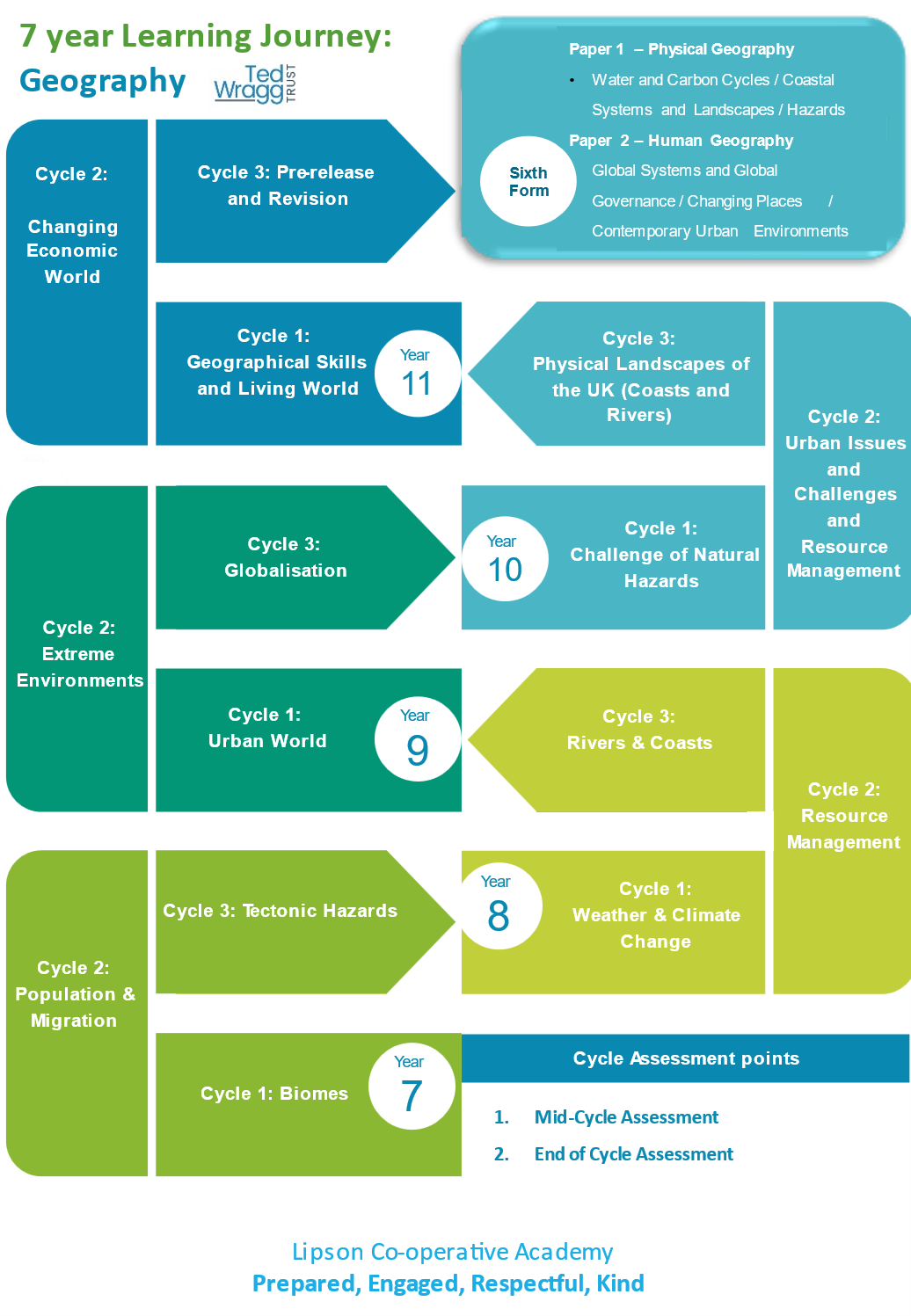
Our Curriculum Learning Pathway
Transition & building on KS2
Geography at Lipson is designed to build directly on the knowledge, skills and curiosity developed at primary level, while deepening understanding and increasing academic challenge.
We extend students’ understanding of places and environments to a wider national and global scale. We aim to deepen knowledge of physical and human processes, develop more advanced analytical and enquiry skills, and introduce structured fieldwork. This allows students to move from simple description to critical thinking, evaluating real-world issues and global challenges, preparing them for further study and responsible citizenship.
Implementation
What do our students learn?
Geography helps students understand how the world works at local, national, and global scales. Students will study:
- Physical Geography (such as rivers, climate, and natural hazards).
- Human Geography (including cities, population, and development).
- Geographical Skills (map use, data analysis, fieldwork, and critical thinking).
The subject prepares students to understand global challenges and become informed, responsible citizens.
What Examination Courses do we follow?
Our students follow AQA GCSE Geography and AQA A Level Geography.
How do we enrich our subject outside the classroom?
Geography enriches learning beyond the classroom by helping students understand and engage with the real world around them. Through fieldwork and local investigations across KS3, KS4 and KS5, students connect classroom knowledge to their own environments and communities. Fieldwork visits include trips to the Eden Project and Cadover Bridge.
Impact
Geography is about far more than examination success. It equips students with the knowledge, skills, and understanding needed to engage confidently with the world. Through geography, students develop resilience, strong enquiry and research skills, and the ability to work both independently and collaboratively. They learn to solve problems, ask meaningful questions, and become informed about the key issues that shape their lives and futures. Geography empowers students to find their voice and make a positive contribution to society.
Geography is an excellent foundation for a wide range of future pathways and careers, including environmental science, urban planning, international development, business, engineering, and the social sciences. Most importantly, it equips students with the knowledge and skills needed to understand a rapidly changing world and contribute positively to its future.
How do you measure attainment and progress?
We measure student progress based on the following assessment objectives:
- AO1: Knowledge of locations, places, processes, environments and scales
- AO2: Geographical understanding of: concepts and how they are used in relation to places, environments and processes
- AO3: Apply knowledge and understanding to interpret, analyse and evaluate issues to make judgements
- AO4: Select, adapt and use a variety of skills and techniques to investigate questions and issues.
Useful websites and Reading Opportunities
KS3 Geography Revision: https://www.bbc.co.uk/bitesize/subjects/zrw76sg
GCSE Geography Specification: https://www.aqa.org.uk/subjects/geography/gcse/geography-8035/specification/specification-at-a-glance
GCSE Geography Revision: https://www.bbc.co.uk/bitesize/examspecs/zy3ptyc
A Level Geography Specification: https://www.aqa.org.uk/subjects/geography/a-level/geography-7037/specification/specification-at-a-glance
A Level Geography Revision: https://www.physicsandmathstutor.com/geography-revision/a-level-aqa/