Science
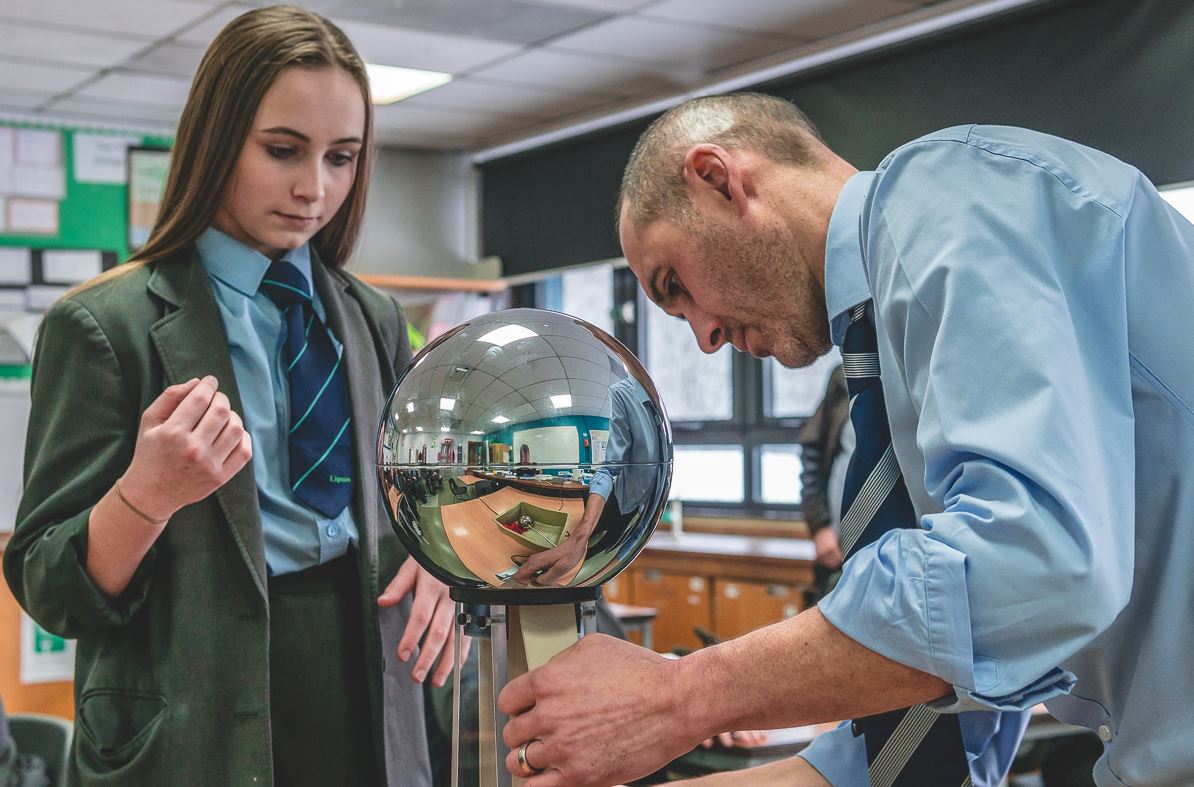
When you step into a science lab at Lipson, you embark on an adventure of possibility. Science ignites curiosity, interest and enjoyment in all our students whilst furnishing them with the necessary skills to successfully explore the world around them.
Science starts with an idea and then equips you with the skills to prove or disprove it. Seeing the relationship between empirical evidence and your theory helps you think critically. These important thinking skills can be applied in many areas of study and nourishes a developing mind.
Science feeds a natural love for learning. Science is hands-on, it appeals readily to most students.
Science opens doors to many disciplines. Building an aptitude for science can be helpful in other areas of study; science encourages math, creativity and argument. An interest in science is an interest in how things were once understood compared to how they are understood now so studying science also lends itself easily to studying history. And hand-in-hand with every lab experiment is the report – thus writing becomes a crucial part of science. Even the study of language itself is a part of science; its specialist terminology can be traced back to Latin or Ancient Greek.
Science prepares our students for the future. It is the basis for life. We literally eat, sleep and breathe science.
Our curriculum has been designed to enable all learners to gain skills in biology, chemistry & physics in a theoretical and practical sense.
Meet the Team
The science team are a passionate department of biologists, chemists, physicists, investigators, experimenters and researchers.
- Dan Gage – Head of Science
- Sam Chick – Teacher of Science, Achievement and Progress Lead
- Katy Hooper - Teacher of Science, Curriculum Coordinator
- Jake Baldry-Roberts - Teacher of Science
- Holly Bowman-Powell- Teacher of Science
- Ellie Casenove - Teacher of Science
- Tony Connett - Teacher of Science
- Nikki Holmes – Teacher of Science
- Sam Jones - Teacher of Science
- Thomas Marks - Teacher of Science
- Hayley Roach - Teacher of Science
- Steve Watson - Teacher of Science
- Steph Rosser – Senior Science Technician
- Hayley Edwards - Science Technician
Building on Key Stage 2
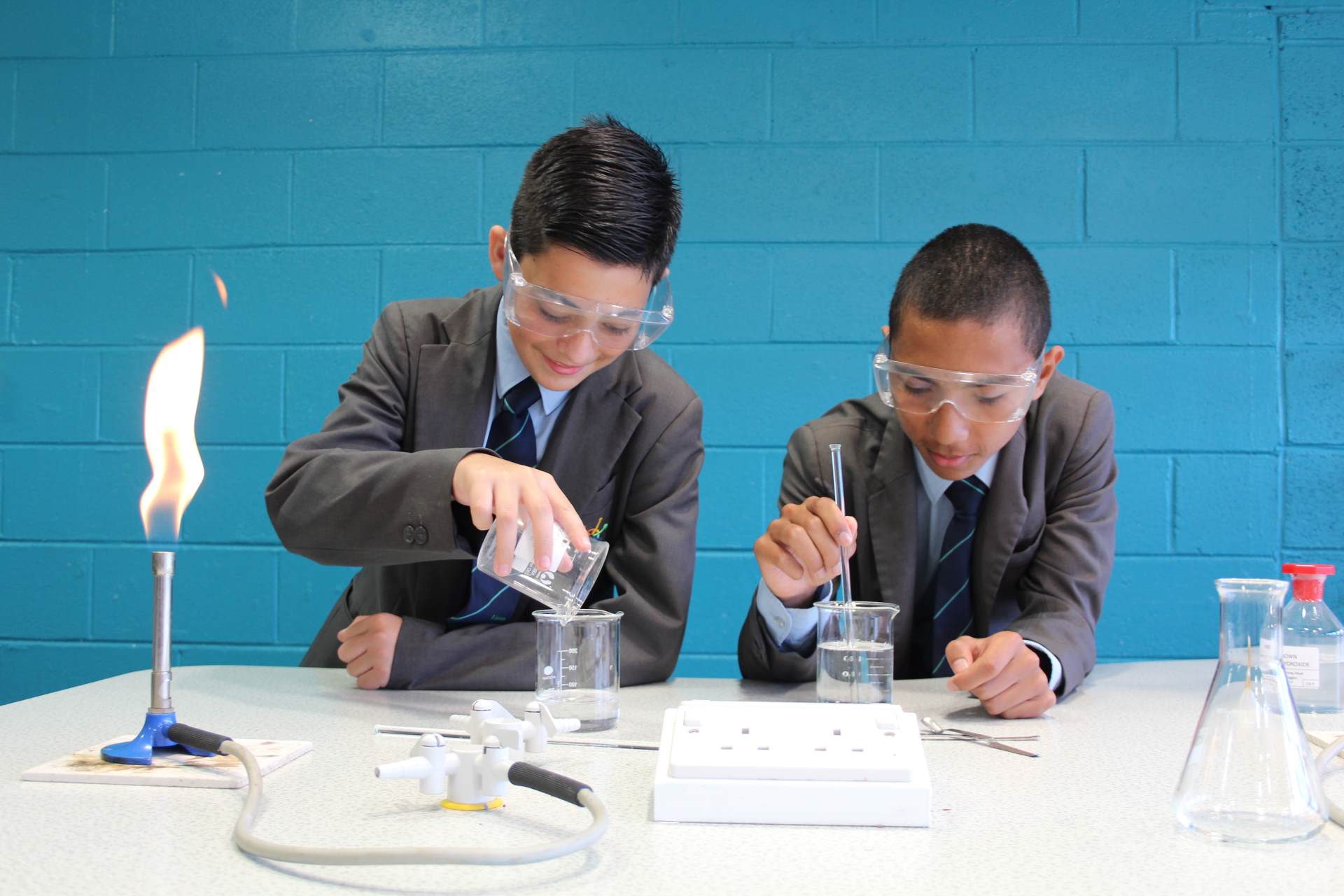
As a department, we collaborate with our local Primary schools to identify what is being taught in Year 5 & 6 and how. Moreover, we run workshops where we explore the exciting practical nature of science- we love making lessons explosive!
Our Year 7 learning builds on the KS2 curriculum and develops students’ knowledge and skills so they are equipped with the skills that will assist them in KS4 and beyond.
Our Curriculum Learning Pathway
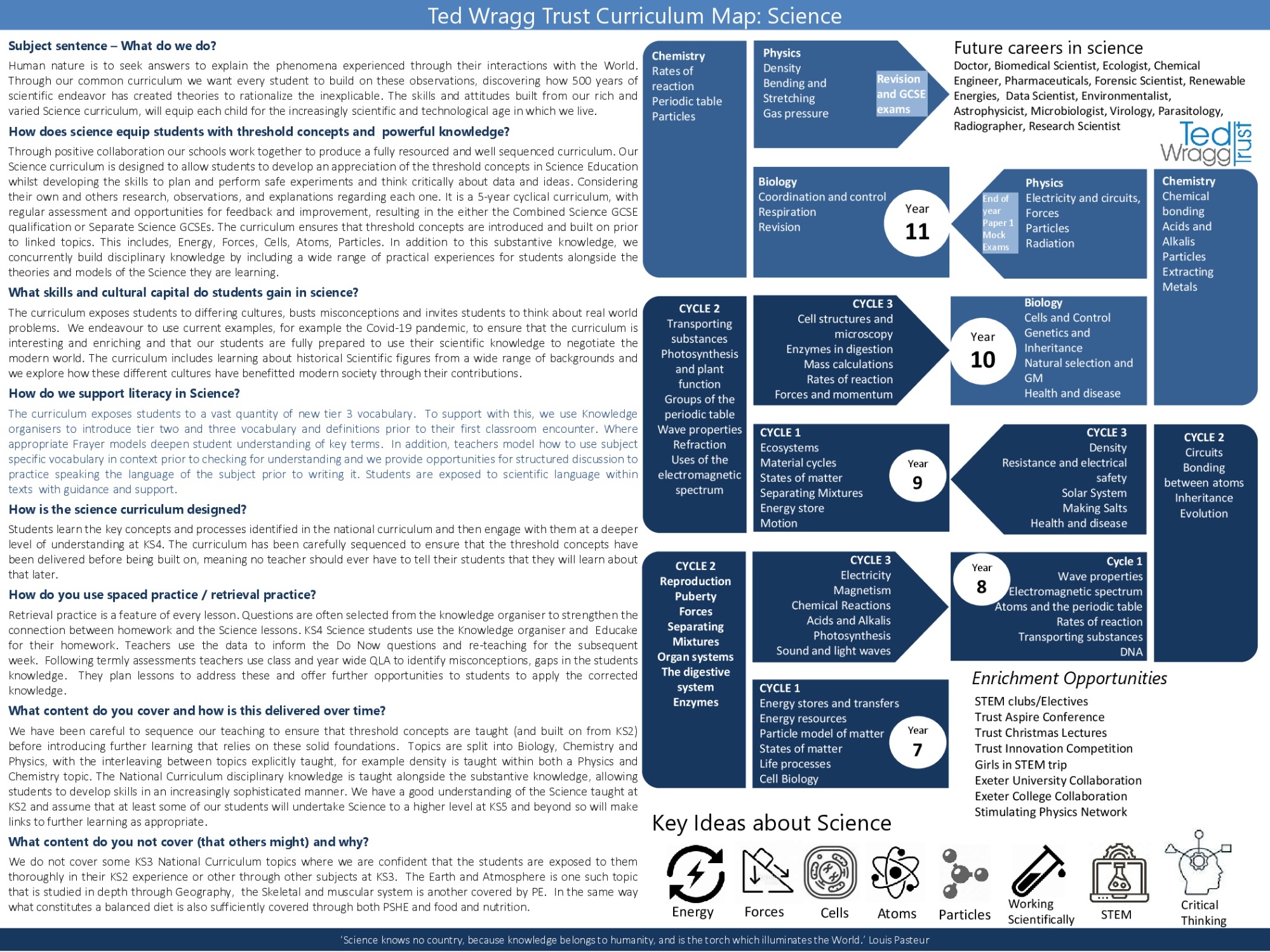
Science Curriculum Pathway (PDF)
Key Stage 3
In years 7, 8 & 9 students have 7 hours of Science per fortnight. The curriculum has been thoughtfully sequenced to aid learning of both scientific content and skills. Across the Key Stage, the following topics are covered which both meet and stretch beyond the National Curriculum.
|
Biology |
Chemistry |
Physics |
|
|
Cells Food chains and webs Ecosystems Genes Variation Human reproduction Breathing Drugs, smoking & alcohol Digestion & diet Respiration Photosynthesis Evolution Inheritance DNA & genetics |
Physical states Elements, mixtures & compounds Separation of mixtures Acids and alkalis Reactions of metals Earth’s structure Elements & Compounds The Periodic Table Reactions of Group 1, 7 and 0 Types of reactions Energy changes in reactions Global warming & climate change Carbon cycle Extracting metals and recycling |
Forces Speed Gravity Circuits Energy Sound Friction Magnets and electromagnets Work and energy Energy transfers Waves Radiation and energy |
|
Useful website links
BBC Bitesize - KS3 Science
Key Stage 4
Students begin their GCSE journey in Year 9 with the initial topics from GCSE that are closely linked to previous learning, for example, cells in Biology and atomic structure in Chemistry and Physics.
Science is studied for 10 hours per fortnight by all students in Year 10 and Year 11. Throughout the Key Stage, students will cover the content and skills required to develop as budding young scientists and have the ability and confidence to continue their studies at the next level should they wish to.
Regular practical work will help them to develop a deeper understanding of scientific processes, which they learn to apply to the theory work that accompanies it. Content and skills are assessed via six examinations at the end of Year 11, split into the following exam papers:
- Biology Paper 1: Tests core biology ideas including cells, genetics, evolution, and disease.
- Biology Paper 2: Focuses on plants, homeostasis, animal transport systems, and ecosystems.
- Chemistry Paper 1: Covers atomic structure, bonding, mixtures, chemical changes, and metal extraction.
- Chemistry Paper 2: Assesses periodic table groups, rates of reaction, fuels, Earth science, and chemical analysis.
- Physics Paper 1: Examines motion, forces, energy, waves, light, and radioactivity.
- Physics Paper 2: Tests astronomy, electricity, magnetism, particle model, and forces in matter.
All examination papers are 70 minutes in length and worth 60 marks.
Key Stage 5
The Science department offers a range of courses that enable students in Years 12 & 13 to continue their scientific studies. These courses are designed to continue building their scientific skills and understanding and to prepare them for their future lives, be that further study at University or if they leave education and seek employment.
An overview of each of the courses:
Exam Board – OCR Biology A
Year 12
- Module 1: Development of practical skills in biology
- Module 2: Foundations in biology
- Module 3: Exchange and transport
- Module 4: Biodiversity, evolution and disease
Year 13
- Module 5: Communication, homeostasis and energy
- Module 6: Genetics, evolution and ecosystems
Examinations
- Paper 1: Biological processes, 2 hours 15 minutes
- Paper 2: Biological diversity, 2 hours 15 minutes
- Paper 3: Unified biology, 1 hour 30 minutes
Useful website links.
Royal Society of Biology - Royal Society of Biology
Useful books
A Level Biology A for OCR Student Book – Ann Fullick, Jo Locke & Paul Bircher (Oxford)
A Level Chemistry
Exam Board - OCR Chemistry A
Year 12
- Module 1: Development of practical skills in chemistry
- Module 2: Foundations in chemistry
- Module 3: Periodic table and energy
- Module 4: Core organic chemistry
Year 13
- Module 5: Physical chemistry and transition elements
- Module 6: Organic chemistry and analysis
Examinations
- Paper 1: Periodic table, elements and physical chemistry
2 hours and 15 minutes, 100 marks - Paper 2: Synthesis and analytical techniques
2 hours and 15 minutes, 100 marks - Paper 3: Unified chemistry
1 hour and 30 minutes, 70 marks
Useful website links.
- Kerboodle - Lessons, Resources, Assessment, and Kerboodle Books
- Royal Society of Chemistry - The Royal Society of Chemistry
Useful books
A Level Chemistry A for OCR Student Book - Rob Ritchie and Dave Gent (Oxford)
A level Physics
Exam Board - OCR Physics A
Year 12
- Module 1: Development of practical skills in physics
- Module 2: Foundations of physics
- Module 3: Forces and motion
- Module 4: Electrons, Waves and Photons
Year 13
- Module 5: Newtonian World and Astrophysics
- Module 6: Particles and medical physics
Examinations
- Paper 1: Modelling physics
2 hours 15 minutes, 100 marks - Paper 2: Exploring physics
2 hours 15 minutes, 100 marks - Paper 3: Unified physics 1
hour 30 minutes, 70 marks
Useful website links.
- Kerboodle - Lessons, Resources, Assessment, and Kerboodle Books
- Institute of Physics - Institute of Physics - For physics • For physicists • For all : Institute of Physics
Useful books
A Level Physics A for OCR - Graham Bone and Gurinder Chadha (Oxford)
BTEC National Applied Science (Level 3)
Examination board Edexcel – BTEC National Applied Science
The course consists of 5 units:
Year 12
- Unit 1: Principles and Applications of Biology (External Exam)
- Unit 2: Principles and Applications of Chemistry (External Exam)
- Unit 3: Principles and Applications of Physics (External Exam)
Year 13
- Unit 4: Practical and Scientific Procedures and Techniques (Internal Assessment)
- Unit 5: Science investigation skills (Internal Assessment)
Useful website links.
Pearson - Applied Science (AAQ) Specification
Long Term Plan Documents