
Modern Foreign Languages
“Parler une autre langue, c’est posséder une deuxième âme."
"To speak another language is to possess a second soul.”
CHARLEMAGNE
We are a department of passionate, specialist linguists, who have all experienced and benefitted from time living abroad, immersed in the cultures of the languages that we speak.
Meet the team
- Joanne Taljaard – Head of Modern Foreign Languages
- Natasha Fletcher - Teacher of French
- Helen Green - Teacher of French
- Jake Baldry-Roberts - Teacher of French
Curriculum Intent
At Lipson, our intention in teaching French is to provide all students with a high-quality language education that develops their ability to communicate confidently and accurately, while also broadening their understanding of the world.
Our French curriculum is designed so that students:
- Build secure knowledge of vocabulary, grammar and pronunciation
- Develop confidence and competence in listening, speaking, reading and writing
- Communicate ideas, opinions and information clearly in spoken and written French
- Gain an understanding of Francophone cultures and global perspectives
- Are well prepared for success in the AQA GCSE French specification (first assessed in 2026) and future pathways
We aim to foster curiosity, resilience and independence, ensuring that all students, regardless of starting point, can make strong progress in French.
Our Curriculum Learning Pathway - French
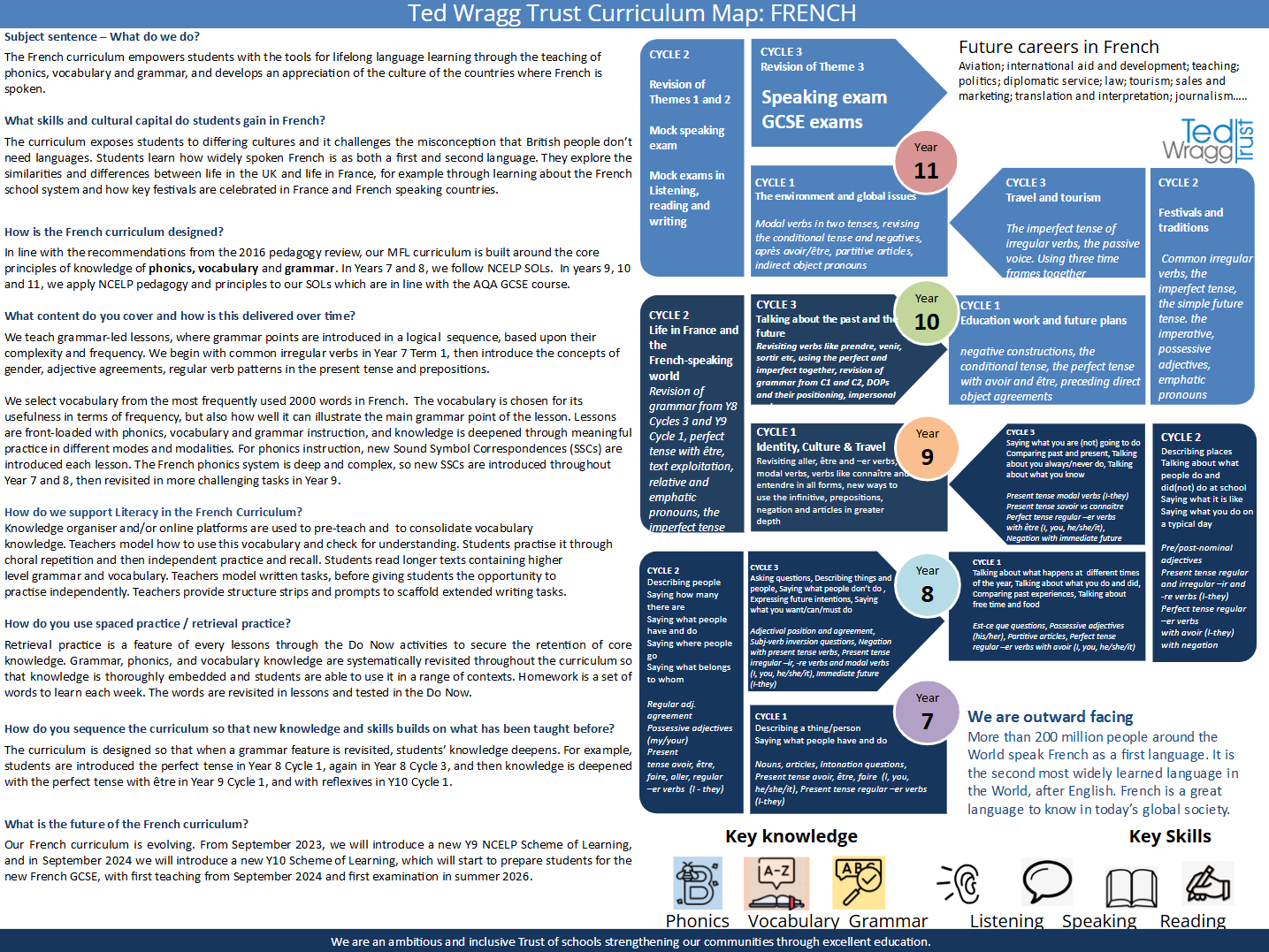
French Curriculum Pathway (PDF)
Curriculum Implementation
The French curriculum is carefully planned and sequenced to ensure that new knowledge builds logically on what students already know. Learning in Key Stage 3 is based on the LDP (Languages Driven Pedaggy) Curriculum which provides the foundations in vocabulary, grammar and phonics that students need to succeed at GCSE.
At Key Stage 4, students study the AQA GCSE French course (8652), which is structured around three broad themes. These themes provide contexts for learning and assessment, and give students opportunities to communicate personally meaningful responses in all four language skills.
Themes and Topics
Theme 1: People and lifestyle
Students understand and produce French about personal life, relationships and everyday wellbeing.
- Identity and relationships with others — e.g., describing yourself, family & friends, relationships.
- Healthy living and lifestyle — e.g., food and diet, exercise, health habits.
- Education and work — e.g., school life, subjects, future jobs/careers.
Theme 2: Popular culture
Focuses on how people spend their time, cultural events and fame.
- Free-time activities — leisure, hobbies, sport, media use.
- Customs, festivals and celebrations — traditional and modern festivities.
- Celebrity culture — fame, celebrities, pros/cons of being famous.
Theme 3: Communication and the world around us
About travel, tech and environmental/social life beyond the individual.
- Travel and tourism, including places of interest — holidays, cities, tourism.
- Media and technology — digital life, social media, communication tech.
- The environment and where people live — environmental issues, towns and lifestyles.
These themes ensure that students learn vocabulary and structures they can apply in authentic contexts, making meaningful connections between language and the world.
Students are assessed across four equally weighted skills:
- Listening – understanding spoken French
- Speaking – communicating and interacting orally
- Reading – understanding written French texts
- Writing – producing accurate and extended written French
Each skill contributes 25% of the final grade, and students are entered for either Foundation (grades 1–5) or Higher (grades 4–9) tier.
Curriculum Impact
By the end of their French studies, students:
- Can communicate confidently and accurately in French
- Demonstrate secure knowledge of key vocabulary, structures and topics
- Show clear progress across all four language skills
- Are well prepared for and achieve positive outcomes in GCSE French
- Develop transferable skills such as communication, confidence and cultural awareness
Students leave Lipson with a greater understanding of the world around them and the skills needed to engage positively in an increasingly global society.
Our curriculum at both KS3 & KS4 is implemented through:
- a minimum of 4 hours per fortnight of teaching time at KS3 / 5 hours per fortnight at KS4.
- teaching the phonics of the target language.
- extensive planned practice in translating and reproducing language accurately as well as recognising patterns in it.
- ensuring students have a systematic knowledge of the vocabulary and grammar of the target language and how to manipulate it.
- giving students the skills to be able to communicate comfortably within three time frames (past, present, future).
- equipping students to understand, give and justify opinions on a range of topics .
- building confidence so that students can express themselves in the target language.
- providing students with the skills they need to confidently sit exams and have strategies to cope with the unknown.
- using authentic resources from the target language countries when possible.
- developing reading fluency so that students can read with intonation, prosody, speed and stamina.
- developing writing fluency through the deliberate teaching of sentence construction, explicitly focusing on the main clause and the addition of component parts.
Useful websites:
- Linguascope - https://www.linguascope.com/
- Quizlet - https://quizlet.com
- Seneca- https://senecalearning.com/en-GB/
- BBC Bitesize - www.bbc.co.uk/bitesize
- Memrise - https://www.memrise.com/
- This is Language - https://www.thisislanguage.com/
- Word Reference (online dictionary) - https://www.wordreference.com/
- Lyrics Training - www.lyricstraining.com